


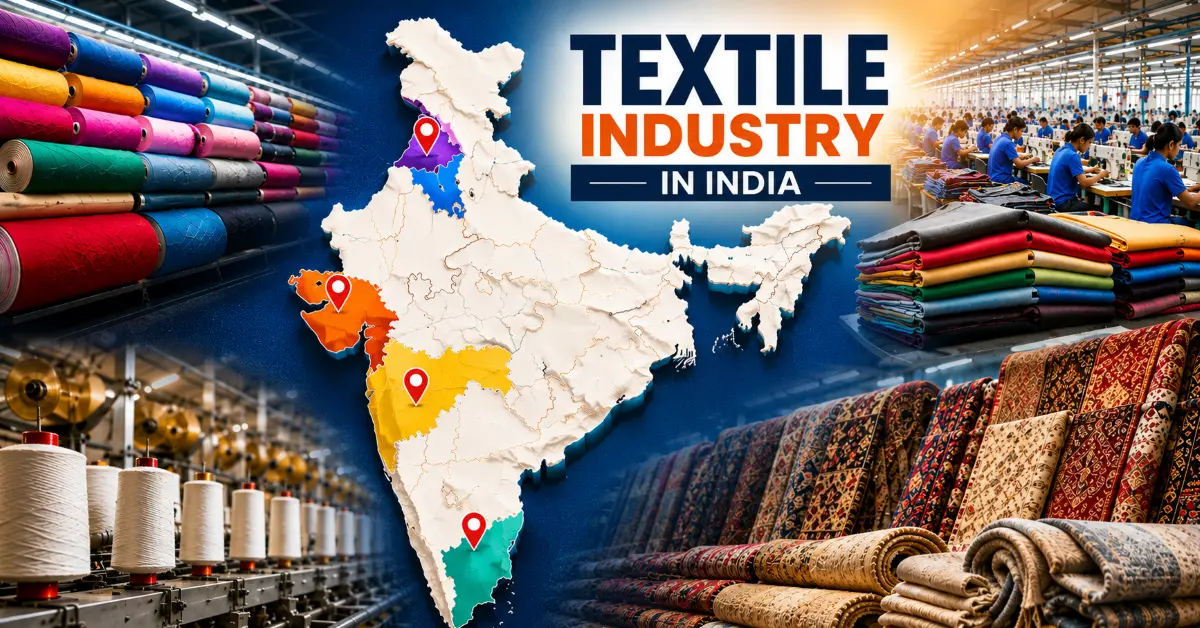
India’s Expanding Textile Landscape
The textile industry in India state wise plays a major role in making India one of the world’s leading textile producers. From cotton farming to garment exports, the textile industry in India supports millions of people and contributes strongly to the country’s economy. But have you ever wondered why some states are famous for cotton textiles while others are known for silk, garments, or synthetic fabrics?
That is because every state has its own strength in the Indian textile industry. Gujarat leads in synthetic fabrics and polyester production; Tamil Nadu dominates knitwear and garment exports, while Maharashtra is famous for spinning mills and cotton processing. These state-wise specialisations make the textile sector in India highly diverse and powerful.
Today, the growth of textile production in India is increasing because of modern factories, export demand, government support, and rising global interest in Indian textiles. Cities like Surat, Tiruppur, Ludhiana, and Panipat have become important textile centres that support both domestic and international markets.
In this guide by textiletrendshub.com, we will explore the textile industry in India state wise covering the top textile states, major textile cities, manufacturing hubs, textile clusters, and future growth opportunities. Understanding the textile industry in India state wise helps readers know how different states contribute to India’s textile success story.
Overview of the Textile Industry in India State Wise
Understanding the textile industry in India state wise helps explain how different states specialise in various textile activities across the country. India is one of the world’s largest producers of cotton, silk, yarn, fabrics, and garments. The country has a strong presence in both traditional and modern textile segments.
An overview of the textile industry in India shows that the sector contributes significantly to GDP, exports, and employment. Millions of people work directly or indirectly in textile manufacturing in India, making it one of the country’s biggest employment-generating industries after agriculture.
The growth of the textile industry in India state wise is mainly supported by strong textile clusters, advanced factories, and skilled workers. Gujarat focuses on synthetic fabrics and processing; Tamil Nadu leads in spinning and knitwear, while Punjab is famous for hosiery products. This state-wise specialisation improves efficiency and supports large-scale fabric production.
The Indian textile sector also contributes heavily to the global textile market through exports of garments, yarn, home textiles, and fabrics. Increasing textile exports have helped India strengthen its position in the international market.
Overall, the textile industry in India state wise shows how different states contribute uniquely to the growth of the Indian textile sector.
Top Textile Manufacturing States in India
India’s state-wise textile industry includes several states that dominate different textile segments. These states are known for strong infrastructure, skilled labour, large factories, and active textile markets.
Some of the top states in the top 10 textile industries in India include Gujarat, Maharashtra, Tamil Nadu, Punjab, Haryana, Rajasthan, Karnataka, and West Bengal. These states are home to some of the biggest textile cities in India and many major textile hubs in India.
Gujarat is famous for synthetic fabrics and textile processing, while Tamil Nadu is known for garment exports and spinning mills. Maharashtra has strong cotton processing and textile manufacturing, whereas Punjab and Haryana specialise in hosiery and home textiles.
The success of the state-wise textile industry in India depends on how each state develops its own textile strengths and supports industrial growth through innovation and exports.
Textile Industry in Gujarat
Gujarat plays a major role in India’s state-wise textile industry and is one of the strongest textile-producing states in the country. The textile industry in Gujarat plays a major role in India’s economy because of its large manufacturing capacity, modern infrastructure, and strong export network. From cotton textiles to synthetic fabrics, Gujarat contributes significantly to the growth of the Indian textile sector.
The textile industry in Surat is widely known for its massive textile market and large-scale fabric production. The city is famous for synthetic sarees, dress materials, polyester fabrics, and textile processing units. Because of its huge production capacity, Surat is often considered one of the leading textile hubs in India. Thousands of textile traders, workers, and manufacturers operate in the city every day.
The state-wise textile industry in India also highlights Gujarat as a leader in the synthetic textile industry. Surat especially dominates the production of polyester fabrics and artificial textiles. The city has a strong powerloom industry, where thousands of powerloom machines produce fabrics on a large scale. These powerlooms help increase fabric production and support both domestic sales and exports.
Ahmedabad is another important textile city in Gujarat and is historically known as the Manchester of India. The city has a strong weaving industry and continues to support textile manufacturing through spinning mills, processing units, and fabric markets.
The textile industry in India, on a state-wise basis, also benefits from Gujarat’s strong export contribution. The state exports fabrics, garments, and processed textiles to many countries around the world. With advanced infrastructure and industrial growth, Gujarat continues to strengthen the textile industry in India state-wise and remains one of the most important textile states in India.
Textile Industry in Maharashtra
Among the strongest contributors to India’s state-wise textile industry, Maharashtra stands out as a leading textile-producing state. The textile industry in Maharashtra has a rich industrial history and continues to contribute strongly to India’s textile growth. From cotton cultivation to yarn production and garment exports, Maharashtra supports many important activities in the textile supply chain.
Mumbai played a major role in the development of the cotton textile industry in India and was once called the country’s textile capital. The city became famous for its large textile mills, business networks, and trading activities. Even today, Mumbai remains an important centre for the growing textile market, fashion businesses, and apparel companies.
Important textile cities like Ichalkaranji, Solapur, and Nagpur also strengthen the state-wise textile industry in India. Ichalkaranji is widely known for its advanced weaving sector and large powerloom industry. The city has many modern spinning mills, textile factories, and fabric manufacturing units that support textile production across India.
Solapur is another well-known textile city famous for towel production, bedsheets, and traditional textile products. Nagpur also plays an important role in cotton trading and cotton processing because of its strong connection with Maharashtra’s cotton-growing regions.
The state is also growing rapidly in garment manufacturing, supported by skilled workers, industrial infrastructure, and increasing export demand. Maharashtra has many famous textile mills in India that produce yarn, fabrics, garments, and other textile products for domestic and international markets.
The textile industry in Maharashtra continues to attract investments because of its strong transportation network, industrial development, and access to raw materials. Overall, the state-wise textile structure in India highlights Maharashtra as a major textile powerhouse that supports employment, exports, and modern textile manufacturing in India.
Textile Industry in Tamil Nadu
In South India, India’s state-wise textile industry places Tamil Nadu among the leading textile-producing states because of its strong manufacturing network, skilled workforce, and export-focused production system. The textile industry in Tamil Nadu plays an important role in strengthening the Indian textile sector and contributes heavily to the country’s economy.
Tamil Nadu is widely known for its large number of spinning mills, textile factories, and garment units. The state produces cotton yarn, knitted fabrics, home textiles, and ready-made garments on a massive scale. Because of this strong industrial base, Tamil Nadu has become one of the most important textile states in India.
The textile industry in Tiruppur has made the city a global centre for knitwear and is often called the knitwear capital of India. The city is famous for T-shirts, sportswear, innerwear, and other knitted garments. Tiruppur exports products to many international markets, making it one of the strongest centres for garment manufacturing and knitwear production in the country.
As one of India’s leading spinning centres, Coimbatore contributes strongly to the state-wise textile industry in India. The city has thousands of textile units and modern spinning factories that support yarn production for manufacturers across India. Coimbatore’s strong industrial ecosystem has helped Tamil Nadu become a leader in textile production.
Erode is another major textile city famous for fabric trading and wholesale textile markets. The city supports cotton fabric sales, dyeing units, and textile processing activities. Together, Tiruppur, Coimbatore, and Erode strengthen the state’s growing apparel industry and improve India’s global textile presence.
Textile exports from Tamil Nadu continue to grow because of modern infrastructure, skilled labour, and increasing international demand. As a result, Tamil Nadu stands as one of the strongest pillars of India’s textile economy in the state-wise textile industry structure in India.
Textile Industry in North India: Punjab & Haryana
North India has an important position in India’s state-wise textile industry because Punjab and Haryana are known for hosiery products, woollen garments, carpets, and home textiles. These states have built strong textile markets through skilled workers, manufacturing units, and growing export activities. Their contribution helps India strengthen both domestic textile production and international trade.
Punjab is especially famous for the textile industry in Ludhiana, which is considered one of the largest hosiery hubs in India. Ludhiana produces sweaters, jackets, socks, thermal wear, and many other winter garments on a large scale. The city has thousands of textile factories and knitting units that support employment for lakhs of workers. Ludhiana also plays a major role in the woollen textile industry, supplying woollen products to markets across India and abroad. Because of its advanced textile ecosystem, the city has become one of the leading textile manufacturing centres in North India.
Haryana also contributes strongly to the state-wise textile industry in India, especially through Panipat. The textile industry in Panipat is famous for home furnishing products such as blankets, carpets, rugs, curtains, and bedsheets. Panipat is often called the “City of Weavers” because of its strong weaving traditions and large textile market. Many small and medium-sized textile businesses operate in the city and support exports to different countries.
Punjab and Haryana together have several growing textile clusters that improve industrial growth and employment opportunities. The region also has a strong handloom sector, where many families are involved in traditional weaving and textile activities. These states contribute significantly to fabric production and continue to strengthen the textile sector in India with specialised textile products, modern factories, and skilled labour.
Emerging Textile States in India
Today, India’s state-wise textile industry is expanding rapidly, with many new states developing into major textile centres. Along with traditional textile states like Gujarat and Tamil Nadu, several emerging states are now contributing strongly to the growth of the textile sector in India. These states are improving infrastructure, attracting investments, and supporting both traditional and modern textile businesses.
Karnataka is one of the leading states for silk production in India. Mysore silk is famous across the country for its quality and smooth texture. The state also supports garment factories and modern textile units, making it an important part of textile manufacturing in India. Karnataka is also focusing on technical textiles and export-oriented production.
Rajasthan is well known for its colourful fabrics, hand block printing, and traditional textile crafts. Cities like Jaipur and Bhilwara play an important role in fabric processing and textile trade. The state’s growing textile industry helps preserve traditional Indian textiles while also supporting modern manufacturing.
West Bengal is another emerging textile state known for handlooms, weaving, and jute products. The state has a strong textile culture and continues to support small-scale textile businesses and artisans.
The rising contribution of Andhra Pradesh and Telangana is strengthening the state-wise textile industry in India. These states are developing textile parks, improving industrial infrastructure, and supporting textile exports through various government initiatives. Many companies are investing in spinning, weaving, and technical textile projects in these regions.
With better infrastructure and government support, India’s state-wise textile industry is expected to grow further in these emerging textile states in the coming years.
Major Textile Cities and Clusters in India
Across the country, many specialised textile cities and industrial regions strengthen India’s state-wise textile industry. These cities play a major role in fabric manufacturing, garment production, exports, and textile processing. Because different regions focus on different textile products, India has developed some of the strongest textile clusters in the world.
Many of the leading textile cities in India are known for their large production capacity and skilled workforce. These cities help India remain competitive in the global textile market while also supporting millions of jobs. The growth of the state-wise textile industry in India is closely connected to these manufacturing centres and regional textile specialisations.
Below are some of the most important textile cities and clusters in India:
| City | State | Specialisation |
| Surat | Gujarat | Synthetic fabrics & polyester textiles |
| Tiruppur | Tamil Nadu | Knitwear & garment exports |
| Ludhiana | Punjab | Hosiery & woollen garments |
| Panipat | Haryana | Carpets, blankets & home textiles |
| Ichalkaranji | Maharashtra | Powerloom & weaving industry |
| Coimbatore | Tamil Nadu | Spinning mills & yarn production |
| Ahmedabad | Gujarat | Cotton textiles & fabric processing |
Surat is often considered a leading textile hub of India because of its massive synthetic textile production. Tiruppur is globally recognised for knitwear exports, while Ludhiana dominates the woollen garment sector. These manufacturing centres have helped create some of the biggest textile hubs in India.
The success of the state-wise textile industry in India depends heavily on these specialised cities, which continue to drive growth, exports, and innovation in the Indian textile sector.
Types of Textile Industry in India
India’s state-wise textile industry includes many different textile segments that support both traditional and modern manufacturing. Understanding the types of textile industry in India helps readers learn how India has become one of the world’s largest textile producers.
The cotton textile industry is the biggest segment in the country. Cotton fabrics, yarn, bedsheets, and garments are produced on a large scale in states like Gujarat and Maharashtra. India is also one of the leading cotton producers in the world, which strongly supports textile manufacturing.
Another important segment is the synthetic textile industry, which mainly focuses on polyester, rayon, and artificial fabrics. Surat is one of the biggest centres for synthetic textile production and is known for its strong powerloom industry.
India is also famous for its traditional handloom sector, where skilled artisans produce handmade sarees, shawls, carpets, and decorative fabrics. States like West Bengal, Rajasthan, and Uttar Pradesh are well known for handloom products.
Apart from cotton and synthetic fabrics, India also has strong silk production and wool manufacturing industries. Mysore silk and Kashmiri wool products are popular across the country.
Today, the state-wise textile industry in India is also growing in technical textiles, which are used in healthcare, construction, agriculture, and industrial applications.
Top Textile Companies and Mills in India
Several leading textile businesses contribute significantly to India’s state-wise textile industry by supporting manufacturing, exports, and fabric production across the country. Several leading brands and manufacturing groups play an important role in the growth of the Indian textile sector.
Some of the popular names among the top textile companies in India include Arvind Limited, Raymond, Vardhman, Welspun, and Trident. These companies are recognised for their strong production capacity, modern factories, and global market presence. Many of these brands manufacture fabrics, garments, home textiles, and yarn for both domestic and international markets.
The growth of the state-wise textile industry in India also depends on the contribution of major textile companies in India and advanced manufacturing units located across different states. Their factories support employment generation, textile innovation, and export growth.
The country also has a long list of textile companies in India, ranging from large corporations to medium- and small-scale industries. Along with these businesses, many textile mills in India continue to support spinning, weaving, and fabric processing activities across the country.
If you want to explore more about spinning units, weaving factories, and the complete list of textile companies in India, you can read our detailed guide on “Textile Mills in India: Types, List & Top Companies Guide“.
Challenges and Future of the Textile Industry in India State Wise
The textile industry in India state wise has achieved strong growth over the years, but the sector still faces several challenges. Rising raw material prices, increasing labour costs, and high electricity expenses are affecting many textile manufacturers across the country. Small textile businesses also struggle to compete with large factories and imported products from other countries.
Global competition is another major challenge for the Indian textile industry. Countries like China, Bangladesh, and Vietnam export textile products at competitive prices, which creates pressure on Indian manufacturers. At the same time, environmental concerns are increasing because textile processing requires large amounts of water and chemicals. This has made sustainability an important topic in the modern textile market.
Despite these challenges, the future of the textile industry in India state wise looks very promising. Government projects like PM MITRA parks are helping improve infrastructure, investment, and modern textile manufacturing facilities. The demand for technical textiles is also growing rapidly in sectors like healthcare, construction, and automobiles.
Increasing textile exports and modern technology are helping improve textile production in India. With innovation, sustainability, and better infrastructure, India’s textile sector is expected to grow strongly in the coming years.
Conclusion
The growth of the textile industry in India is strongly supported by regional specialisations, and the textile industry in India state wise explains how different states contribute to the sector. Gujarat leads in synthetic fabrics and polyester production; Tamil Nadu dominates knitwear and garment exports, while Maharashtra is known for cotton processing and spinning mills. Punjab and Haryana also play an important role in hosiery, carpets, and home textiles.
These state-wise specialisations make India one of the strongest textile-producing countries in the world. The growth of modern factories, exports, technical textiles, and government support is helping the industry expand even further. Many emerging states are also developing new opportunities in textile manufacturing and fabric production.
The future of the textile industry in India state wise looks highly promising as India continues strengthening its manufacturing ecosystem and developing new textile hubs in India.
At textiletrendshub.com, you can also explore our detailed guide on the textile industry in India:
“Unveiling the Textile Industry in India: Economic Impact, Growth Milestones, and Prospects“.

Q1. What is the textile industry in India state wise?
The textile industry in India state wise explains how different states in India specialise in different textile activities. Some states focus on cotton textiles, while others are known for silk production, garment manufacturing, synthetic fabrics, or home textiles. For example, Gujarat is famous for synthetic fabrics, Tamil Nadu leads in knitwear exports, and Maharashtra is known for cotton processing and spinning mills. This state-wise structure helps India strengthen its overall textile production and export capacity.
Q2. Which state is famous for the textile industry in India?
Several states are famous in the Indian textile sector, but Gujarat, Tamil Nadu, and Maharashtra are considered the strongest textile-producing states. Gujarat is known for synthetic fabrics and Surat’s textile market; Tamil Nadu leads in knitwear and spinning mills, while Maharashtra is famous for cotton textiles and garment manufacturing.
Q3. Why is Gujarat important in the Indian textile industry?
Gujarat plays a major role because of its strong synthetic textile industry, advanced processing units, and large export network. Cities like Surat and Ahmedabad are major textile centres known for polyester fabrics, sarees, and fabric production. The state also has a powerful power-loom industry that supports large-scale textile manufacturing.
Q4. Why is Tiruppur called a textile hub?
Tiruppur is called a textile hub because it is one of India’s biggest centres for knitwear and garment exports. The city manufactures T-shirts, sportswear, and other knitted garments for international markets. Its strong export performance has made Tiruppur an important part of India’s apparel industry.
Q5. Which city is known as the Manchester of India?
Ahmedabad is popularly known as the Manchester of India because of its long history in cotton textile manufacturing. The city became famous for spinning mills, weaving factories, and fabric processing units that supported India’s textile growth for many years.
Q6. What are the major textile hubs in India?
Some of the major textile hubs in India include Surat, Tiruppur, Ludhiana, Panipat, Ichalkaranji, Coimbatore, and Ahmedabad. These cities specialise in different textile products such as synthetic fabrics, knitwear, hosiery, carpets, spinning, and cotton textiles.
Q7. Which state leads in silk production in India?
Karnataka is one of the leading states for silk production in India. Mysore silk is especially famous for its quality and smooth texture. The state also supports modern textile factories and garment manufacturing units.
Q8. What is the role of spinning mills in textile manufacturing?
Spinning mills are very important because they convert raw cotton or fibres into yarn, which is later used for fabric production and garment manufacturing. States like Tamil Nadu and Maharashtra have thousands of spinning mills that support India’s textile supply chain.
Q9. Why is Panipat famous in the textile industry?
Panipat is famous for home textiles such as blankets, carpets, rugs, curtains, and bedsheets. The city has a strong weaving tradition and is often called the City of Weavers because of its large textile market and manufacturing units.
Q10. What are textile clusters?
Textile clusters are regions where many textile businesses, factories, workers, and suppliers operate together. These clusters help improve production efficiency, reduce costs, and support employment. Surat, Tiruppur, and Ludhiana are some of India’s most successful textile clusters.
Q11. What types of textiles are produced in India?
India produces many types of textiles, including cotton textiles, synthetic fabrics, silk textiles, woollen products, handloom fabrics, and technical textiles. Different states specialise in different textile segments based on local resources and industrial strengths.
Q12. How does the textile industry support India’s economy?
The textile industry supports India’s economy by generating employment, increasing exports, and contributing to industrial growth. Millions of people work in textile factories, spinning mills, garment units, and handloom businesses across the country.
Q13. Which are the top textile companies in India?
Some of the leading textile companies in India include Arvind Limited, Raymond, Welspun, Vardhman, and Trident. These companies manufacture fabrics, garments, yarn, and home textiles for domestic and international markets.
Q14. What challenges does the Indian textile industry face?
The Indian textile industry faces challenges such as rising raw material prices, labour costs, global competition, and environmental concerns. Textile processing also requires large amounts of water and energy, which makes sustainability an important issue for the future.
Q15. What is the future of the textile industry in India state wise?
The future of the textile industry in India state wise looks very promising because of growing exports, modern factories, technical textiles, and government initiatives like PM MITRA parks. Emerging textile states are also improving infrastructure and attracting investments, which may help India become an even stronger global textile manufacturing hub in the coming years.


