


Introduction
Spinning mills in India are the backbone of the country’s yarn manufacturing industry, but many people don’t realise that every cotton fabric begins its journey inside a spinning mill. Whether it is a T-shirt, bedsheet, denim fabric, or industrial textile, the process starts with raw cotton being converted into yarn. Without spinning mills in India, the textile supply chain would simply stop.
India is one of the world’s largest cotton producers, yet raw cotton alone has limited value. This is where cotton spinning mills play a crucial role. They transform cotton fibres into high-quality yarn, which is supplied to weaving, knitting, and garment manufacturing units. Today, thousands of textile spinning mills in India support employment, exports, and the growth of the broader cotton textile industry.
In this detailed guide by textiletrendshub.com, we will explore the complete spinning process, yarn manufacturing stages, leading production states, major companies, modern technologies, and the growing contribution of spinning mills in India to India’s textile exports and industrial development.
Before diving deeper into spinning, you can explore our detailed guide on the cotton textile industry in India, which explains the industry’s history, raw material production, leading textile states, key growth drivers, and future opportunities.
How Spinning Mills in India Convert Cotton into Yarn
The textile industry depends on several manufacturing stages, but spinning is one of the most important. Spinning mills in India convert raw cotton into yarn, which is later used to produce fabrics, garments, and home textiles. By adding value to raw cotton, these mills support both domestic manufacturing and textile exports. Understanding the spinning process helps explain the importance of the sector in India’s textile economy.
From Cotton Fibre to Yarn
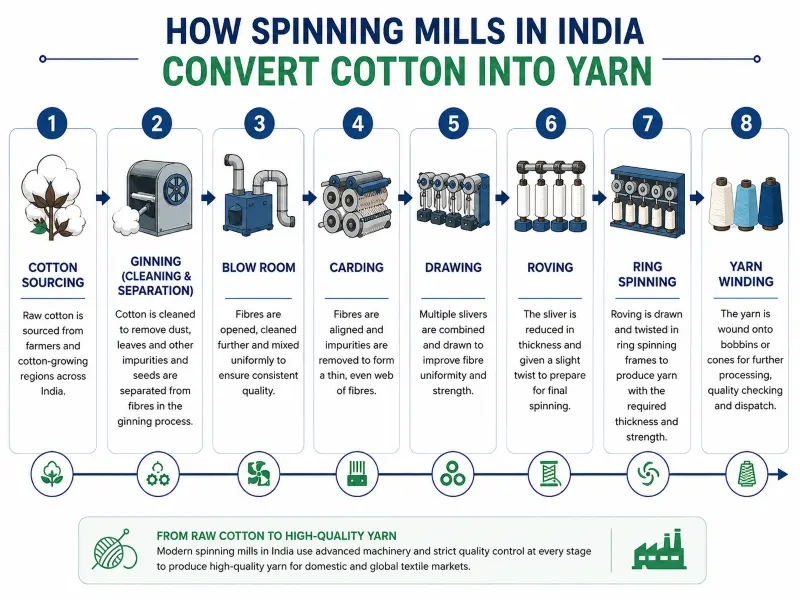
The journey begins with cotton sourced from major cotton-growing regions across the country. Before yarn can be produced, the cotton undergoes ginning, where fibres are separated from seeds. The fibres are then cleaned to remove dust, leaves, and other impurities. After cleaning, the cotton is prepared for further processing to ensure consistent quality and performance.
Many cotton spinning mills carefully select and process raw cotton because fibre quality directly affects the strength and appearance of the final yarn. Modern spinning mills follow strict quality standards during this stage to improve production efficiency and maintain product consistency.
Key Stages in the Spinning Process
After fibre preparation, cotton passes through several important manufacturing stages. The blow room opens and cleans the fibres further before they move to carding, where the fibres are aligned and impurities are removed. During drawing, multiple slivers are combined to improve uniformity and strength. The roving process reduces thickness and prepares the material for final spinning.
The last stage, ring spinning, converts roving into yarn with the required thickness and strength. These carefully controlled processes help spinning textile mills produce quality yarn for different textile applications. Today, many Indian spinning mills use advanced machinery and automation systems to increase productivity and maintain quality standards. As a result, spinning mills in India continue to meet the growing demand for yarn in both domestic and international markets.
Types of Yarn Produced by Indian Mills
Indian manufacturers produce a wide range of yarns to serve different sectors of the textile industry. Cotton yarn is commonly used in apparel, home furnishings, and everyday fabrics. Blended yarn combines cotton with synthetic fibres such as polyester to improve durability and performance. Compact yarn is known for its strength, smoothness, and reduced hairiness, making it suitable for premium fabrics.
In addition, speciality yarns are developed for technical textiles and high-performance applications. Every spinning company focuses on producing yarn that matches specific market requirements and customer expectations. Many leading yarn manufacturers in India listed companies offer diverse product portfolios that support India’s growing textile sector. With continuous innovation and investment, textile spinning mills in India are helping strengthen the country’s position in the global textile market, while spinning mills in India remain a key link between cotton production and fabric manufacturing.
Major Spinning States and Leading Companies in India
India is one of the world’s leading yarn producers, and a major reason behind this success is its extensive network of spinning mills in India. These mills transform raw cotton into yarn, creating an important link between agriculture and textile manufacturing. Supported by cotton production, skilled workers, and modern infrastructure, the spinning sector continues to strengthen India’s position in the global textile market.
Top Spinning States in India
Several states play a major role in the growth of India’s spinning industry. Among them, Tamil Nadu is widely known as the spinning capital of the country. Cities such as Coimbatore, Tiruppur, and Erode are home to a large concentration of spinning mills in India, making the state a leading producer of cotton yarn.
Maharashtra is another important textile hub due to its strong cotton-growing regions and industrial development. Many spinning mills in Maharashtra benefit from easy access to raw materials and transportation facilities. The state is also home to several well-known textile companies in Maharashtra that support different segments of the textile value chain.
In addition, various cotton industries in Maharashtra contribute to the smooth supply of cotton for yarn production. As a result, spinning mills in Maharashtra continue to play a significant role in the country’s textile sector.
Other major states include Gujarat, which is known for its large cotton production, Telangana, which has rapidly expanded its textile infrastructure, and Andhra Pradesh, where modern manufacturing facilities support both domestic and export markets. Together, these states strengthen the presence of spinning mills in India and contribute significantly to India’s textile growth.
List of Leading Spinning Mills and Yarn Manufacturers
When exploring the list of spinning mills in India, several companies stand out for their production capacity, quality standards, and industry leadership. Many of these businesses are recognised among the top spinning mills in India and supply yarn to both domestic and international textile manufacturers.
Some of the leading names include Vardhman Textiles, KPR Mill, Trident, Nitin Spinners, Welspun, RSWM, and Sutlej Textiles. These companies have built strong reputations through continuous investment in technology, product quality, and export growth.
Many of these organisations are also considered famous spinning mills in India and are often featured in discussions about the top 10 spinning mills in India. Operating within the network of spinning mills in India, these manufacturers contribute significantly to yarn production and employment generation.
These Indian spinning mills help strengthen India’s position among the top textile manufacturing companies in India. Their contribution to manufacturing, exports, and innovation also makes them an important part of the broader list of textile industries in India.
| Company | State | Key Focus Area |
| Vardhman Textiles | Punjab | Cotton Yarn & Textiles |
| KPR Mill | Tamil Nadu | Yarn, Fabrics & Garments |
| Trident Group | Punjab | Yarn & Home Textiles |
| Nitin Spinners | Rajasthan | Cotton Yarn & Knitted Fabrics |
| Welspun Living | Maharashtra | Home Textiles & Yarn |
| RSWM | Rajasthan | Cotton, Synthetic & Blended Yarn |
| Sutlej Textiles | Punjab | Cotton & Blended Yarn |
Why India Is a Global Yarn Manufacturing Hub
India’s leadership in yarn manufacturing is supported by abundant cotton availability, a skilled workforce, and a well-established textile ecosystem. Every year, the country produces large quantities of cotton, ensuring a reliable supply of raw material for cotton spinning mills in India.
Another major advantage is the integration of spinning, weaving, processing, and garment manufacturing within the same value chain. This improves efficiency, reduces production costs, and increases competitiveness in global markets.
Continuous modernisation and technology adoption have further strengthened spinning mills in India, enabling them to produce high-quality yarn for international buyers. Many companies counted among the top 10 yarn manufacturing companies in India export yarn worldwide, helping India maintain its reputation as a leading global textile manufacturing hub.
Technology, Exports, and Future of Spinning Mills in India
Modern Technologies Used in Spinning Mills
Over the years, spinning mills in India have adopted advanced technologies to improve productivity, yarn quality, and operational efficiency. Modern mills no longer rely only on manual processes. Today, automation systems help reduce errors, increase production speed, and maintain consistent quality standards.
Many spinning mills use automated material handling systems that move cotton and yarn through different production stages with minimal human intervention. Another important innovation is compact spinning technology, which produces stronger and smoother yarn with fewer imperfections. Rotor spinning is also widely used because it enables faster yarn production and lower manufacturing costs.
In addition, several spinning textile mills have introduced smart monitoring systems that track machine performance, energy consumption, and yarn quality in real time. These technologies help manufacturers improve efficiency, reduce waste, and remain competitive in global textile markets. As a result, spinning mills in India continue to strengthen their position as leading yarn producers.
Export Contribution and Future Growth Opportunities
The contribution of spinning mills in India extends far beyond domestic textile production. India exports a significant volume of cotton and blended yarn to countries across Asia, Europe, and other international markets. The growing demand for high-quality yarn has helped many Indian manufacturers expand their global presence.
Several companies featured among the top 20 spinning mills in India and the top 10 yarn manufacturing companies in India contribute significantly to the country’s textile exports. These exports generate valuable foreign exchange earnings and support thousands of jobs throughout the textile supply chain.
Looking ahead, sustainability and modernisation are expected to shape the future of the industry. Many cotton spinning mills in India are investing in energy-efficient machinery, renewable energy solutions, and environmentally responsible production methods. As the broader list of cotton textile industries in India continues to evolve, spinning mills in India are likely to benefit from technological upgrades, government support, and increasing global demand for quality yarn products.
Conclusion
Spinning mills in India are a vital part of the country’s textile value chain, transforming raw cotton into yarn that supports fabric and garment production. From the cotton-to-yarn spinning process to advanced manufacturing technologies, the sector plays a key role in strengthening India’s textile industry. Leading states such as Tamil Nadu, Maharashtra, Gujarat, Telangana, and Andhra Pradesh continue to drive production, while many Indian spinning mills contribute significantly to domestic demand and exports.
As modernisation and sustainability efforts grow, the top spinning mills in India are well-positioned to remain competitive in global markets. At textiletrendshub.com, we believe the spinning sector will continue to be a major force behind India’s textile growth and export success.
To explore the bigger picture, read our detailed guide on the cotton textile industry in India, where we discuss the industry’s history, production capacity, major textile-producing states, and future growth opportunities.

Q1. What are spinning mills in India?
Spinning mills in India are manufacturing units that convert raw cotton fibres into yarn. This yarn is then supplied to weaving, knitting, and garment manufacturers for fabric production. These mills play a vital role in the textile value chain by adding value to raw cotton and supporting both domestic textile manufacturing and exports.
Q2. What is the spinning process in textile manufacturing?
The spinning process begins with cleaning and preparing cotton fibres. The material then passes through several stages, including blow room, carding, drawing, roving, and ring spinning. Each stage improves the quality and uniformity of the fibres until they are converted into strong and consistent yarn suitable for different textile applications.
Q3. Which states are major hubs for spinning mills in India?
Tamil Nadu is widely recognised as the leading spinning hub in the country due to its large concentration of textile units. Other important states include Maharashtra, Gujarat, Telangana, and Andhra Pradesh, which benefit from strong cotton production, skilled labour, and well-developed textile infrastructure.
Q4. Why is India a global leader in yarn manufacturing?
India has several advantages, including abundant cotton availability, a skilled workforce, and an integrated textile ecosystem. The close connection between spinning, weaving, processing, and garment manufacturing helps improve efficiency and reduce production costs. These strengths enable Indian manufacturers to compete successfully in international markets.
Q5. How are spinning mills contributing to the future of India’s textile industry?
The future of the textile sector is being shaped by automation, smart monitoring systems, energy-efficient machinery, and sustainable manufacturing practices. As global demand for quality yarn continues to grow, spinning mills in India are expected to play an even bigger role in boosting exports, creating jobs, and strengthening India’s textile economy.


